Where to Submit Your Startup in 2026
Most founders dump their product into 80 sites and hear nothing. Here is a one-week order that actually gets visitors, listings, and a few real backlinks.
Sep 20, 20269 min read
On this page
- Where to Submit Your Startup in 2026
- What “submit your startup” actually means
- Prepare the kit once
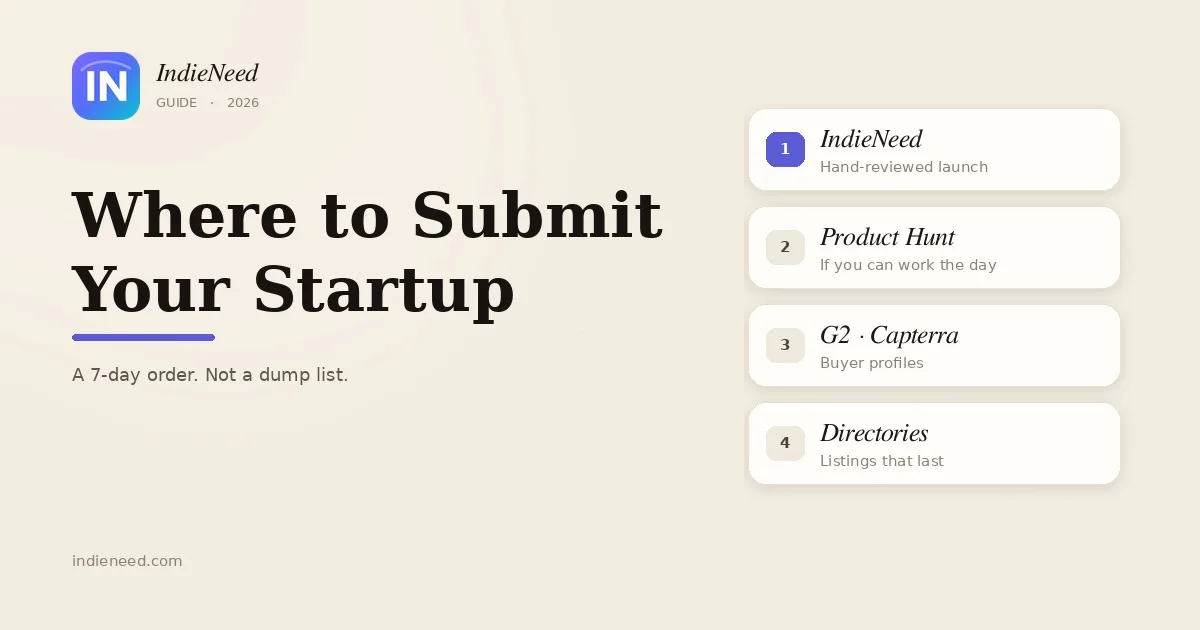
- The 7-day order
- Days 1–2 — launch boards (the spike)
- Days 3–4 — review and company profiles (the entity)
- Days 5–7 — evergreen directories (the trickle)
- What to skip
- A realistic week on a calendar
- How this helps Google (and how it does not)
- Launch on IndieNeed, then do the rest
- FAQ: where to submit your startup
- Where should I submit my startup first?
- What are the best startup submission sites in 2026?
- How many directories should I submit to?
- Should I pay for directory submissions?
- Do directory submissions still work for SEO?
- Where do I submit a SaaS if I am pre-launch?
- Is this the same as a list of startup directories?
Where to Submit Your Startup in 2026
You do not need 80 startup submission sites. You need about a dozen, in the right order, with a listing people can actually understand.
Dumping a product into every form you find is how a week disappears. Most of those pages are dead, paywalled, or never indexed. The founders who get visitors treat submission as a sequence: a launch board for day one, review sites for buyers and brand entity, then startup directories that keep the product findable after the spike fades.
Quick answer: Submit to IndieNeed first (hand-reviewed, stays up). Same week, do Product Hunt if you are ready for a 24-hour race. Then claim G2, Capterra, and Crunchbase. Finish with AlternativeTo, SaaSHub, and the rest of the directory guide. Skip the 300-row lists.
This is where to submit your startup in 2026, and in what order.
What “submit your startup” actually means
Three different jobs get mixed together:
- Launch boards — a public day or week where people upvote, comment, and try the product. Traffic spikes, then drops.
- Review and company profiles — G2, Capterra, Crunchbase. Buyers and journalists already search these. The listing is a trust page more than a launch.
- Directories — lasting catalog pages. Weaker day-one traffic. Better for “best X tool” and “Y alternative” searches months later.
A Product Hunt day is not a Crunchbase profile. A Crunchbase profile is not a SaaSHub page. Submit to each for the job it does, not because a spreadsheet said “DR 90.”
If you want the living catalog of boards — free, paid, SaaS, AI, India — use IndieNeed’s startup directories page. This article is the week-one order, not that catalog.
Prepare the kit once
Every serious form asks for the same things. Write them once.
- Product name people can say out loud
- One-line promise (what it does, for whom)
- Website URL that loads on mobile
- Logo (square PNG) and 3–5 real screenshots
- Short description (~50–80 words) and a longer one (~150–300)
- Category, pricing, and whether it is live or waitlist
- Founder name and a contact email you actually read
- UTM links so you can see which listing sent a visit (
?utm_source=indieneed)
If the listing is vague, every site you submit to will be vague. Fix the product listing before you open the next tab. Run through the SaaS launch checklist if the site itself is still shaky.
The 7-day order
Do not submit everything on Monday. Launch boards reward a real day. Review sites can wait 48 hours. Directories can trickle through the week.
Days 1–2 — launch boards (the spike)
IndieNeed. Start here. The listing is hand-reviewed, it does not vanish at midnight, and it is built for indie makers, AI tools, and small SaaS. Submit your product free, or use a paid launch if you want it live immediately and featured on the homepage. This is the page you can keep sending people to after Product Hunt is over.
Product Hunt. Still the loudest one-day room. Use it if you can be present for the full Pacific-time day, answer comments, and already have a few people who will actually try the product. It is a race, not a directory. If you want other boards like Uneed, Peerlist, BetaList, or Show HN, read the Product Hunt alternatives guide — that article owns that comparison. Do not treat those sites as a second copy of this sequence.
One specialist board, not five. Same week, pick one extra room that matches the product:
- Waitlist / coming soon → BetaList
- Developer tool, API, open source → Show HN or a developer launch pad
- Calmer daily maker board → Uneed or Peerlist Launchpad
Five launch boards in 24 hours means five thin posts and no replies. One extra board, done properly, beats that.
Days 3–4 — review and company profiles (the entity)
These are not “startup directories” in the launch-board sense. They are where buyers, reporters, and later Google look up whether you are a real company.
G2 and Capterra. Claim the product. Use the real name, the real website, and a category a buyer would search. You will not get a flood of reviews on day one. That is fine. The profile is the asset. Do not buy fake reviews.
Crunchbase. A company record, not a launch. Fill it like a grown-up: location, founding year, website, a short description that matches the homepage. Journalists and later hires will open this even if nobody else does.
If you only have four hours on Wednesday, spend them here, not on another upvote site.
Days 5–7 — evergreen directories (the trickle)
After the spike, submit to catalogs that stay indexed.
AlternativeTo. Useful when a buyer searches “[big tool] alternative.” List the product against the thing you actually replace. A dishonest comparison wastes the page.
SaaSHub. SaaS discovery and comparison. Same rule: one clear category, a real screenshot, a website that works.
Then the rest, from the catalog — not from memory. Open the startup directories guide and filter for your case: free, SaaS, AI, or India. Submit to the ones that are still accepting products and still look alive. Skip anything that asks you to install a badge before they will list you, anything that has not been updated in a year, and anything that is obviously a paid link farm.
That is the split on purpose: this article tells you when. The directories page tells you where the full list lives.
What to skip
- Auto-submit services that promise 200 listings by Friday. Half will be spam sites. Some will use a URL you cannot edit later.
- Paying for an upvote pack on a launch board.
- Submitting a waitlist to a directory that only wants live products.
- Submitting the same paragraph to 40 forms without changing the category or the competitor field.
- Chasing a Domain Rating screenshot. A followed link from a page nobody visits is not a strategy.
A realistic week on a calendar
| When | Submit | Why |
|---|---|---|
| Day 1 morning | IndieNeed | Lasting, reviewed listing you control |
| Day 1 (if ready) | Product Hunt | One-day spike |
| Day 1–2 | One specialist board | Audience fit, not volume |
| Day 3 | G2 + Capterra | Buyer intent, company entity |
| Day 4 | Crunchbase | Press / hiring / “are they real?” |
| Day 5–6 | AlternativeTo + SaaSHub | Search traffic that compounds |
| Day 7 | 3–5 more from /directories | Only ones that match the product |
If you launch with no audience, skip Product Hunt until you can answer comments for a full day. IndieNeed plus the review profiles plus two evergreen directories is a complete week.
How this helps Google (and how it does not)
A handful of real listings can:
- Give the brand a few more indexed mentions
- Send referral visits you can measure with UTMs
- Put the product on pages that already rank for category terms
They will not:
- Rank a brand-new domain for a competitive keyword by themselves
- Replace a working website, a clear title tag, or pages that answer a search
- Help if the site is
noindex, blocked, or a coming-soon screen
If the product does not show up for its own name, fix that first. The Google visibility guide covers the boring checks. Directories are a layer on top of a site that already loads and describes itself.
Launch on IndieNeed, then do the rest
IndieNeed is the start of this sequence because the listing stays up. You are not renting 24 hours of a leaderboard and hoping someone bookmarked you.
- Free launch: submit for review
- Faster publish and homepage time: see plans
- Full catalog of other boards: startup directories
Write the listing like a human will read it on a phone. Then walk the table above. Stop when the remaining forms look like the same spam with a different logo.
FAQ: where to submit your startup
Where should I submit my startup first?
IndieNeed, then one launch board that matches the product (often Product Hunt if you can work that day). Review profiles next. Evergreen directories last. First does not mean “highest Domain Rating.” First means a page you still own next month.
What are the best startup submission sites in 2026?
For a launch week: IndieNeed, Product Hunt, and one specialist board. For lasting discovery: G2, Capterra, Crunchbase, AlternativeTo, SaaSHub, plus the live list on startup directories. “Best” depends on whether you want a spike, a buyer page, or a catalog listing.
How many directories should I submit to?
Enough to finish the table above — roughly 8 to 15 well-filled listings — not 80 empty ones. After that, only add a directory if it is specific to your category or country.
Should I pay for directory submissions?
Pay when you are buying time or placement on a site you already trust (a featured launch, a review profile you will maintain). Do not pay a stranger to spray your URL. IndieNeed’s paid launches are for publish speed and homepage featuring on this site, not for a bulk-submit package.
Do directory submissions still work for SEO?
They can help a new product get mentioned and occasionally linked. They are not a substitute for useful pages on your own domain. Treat them as distribution plus a few referral visits, then measure the UTMs.
Where do I submit a SaaS if I am pre-launch?
A waitlist-friendly board (BetaList is the usual one) and an IndieNeed listing if the product is real enough to review. Hold G2/Capterra until someone can actually use it. Do not list a Google Doc as a SaaS.
Is this the same as a list of startup directories?
No. The catalog lives at /directories. This page is the order to submit in, and which jobs each type of site is for.
Launch your product on IndieNeed
Free to submit, hand-reviewed, and you pick the launch day.
Submit a productProducts to explore
Related articles

SaaS Launch Checklist: 25 Things to Check Before You Launch
A simple SaaS launch checklist for founders covering everything worth checking before, during and after launch day.
Sep 15, 202611 min read
Why Your Startup Is Hard to Find on Google in 2026
Launched your startup but cannot find it on Google? Here are the simple things worth checking before worrying about rankings.
Aug 29, 20264 min read

How to Get Your First 100 Users for Your Indie Product
Your product works — but nobody knows it exists. Here's the exact one-week playbook indie makers use to go from zero to their first 100 users.
Aug 14, 20266 min read