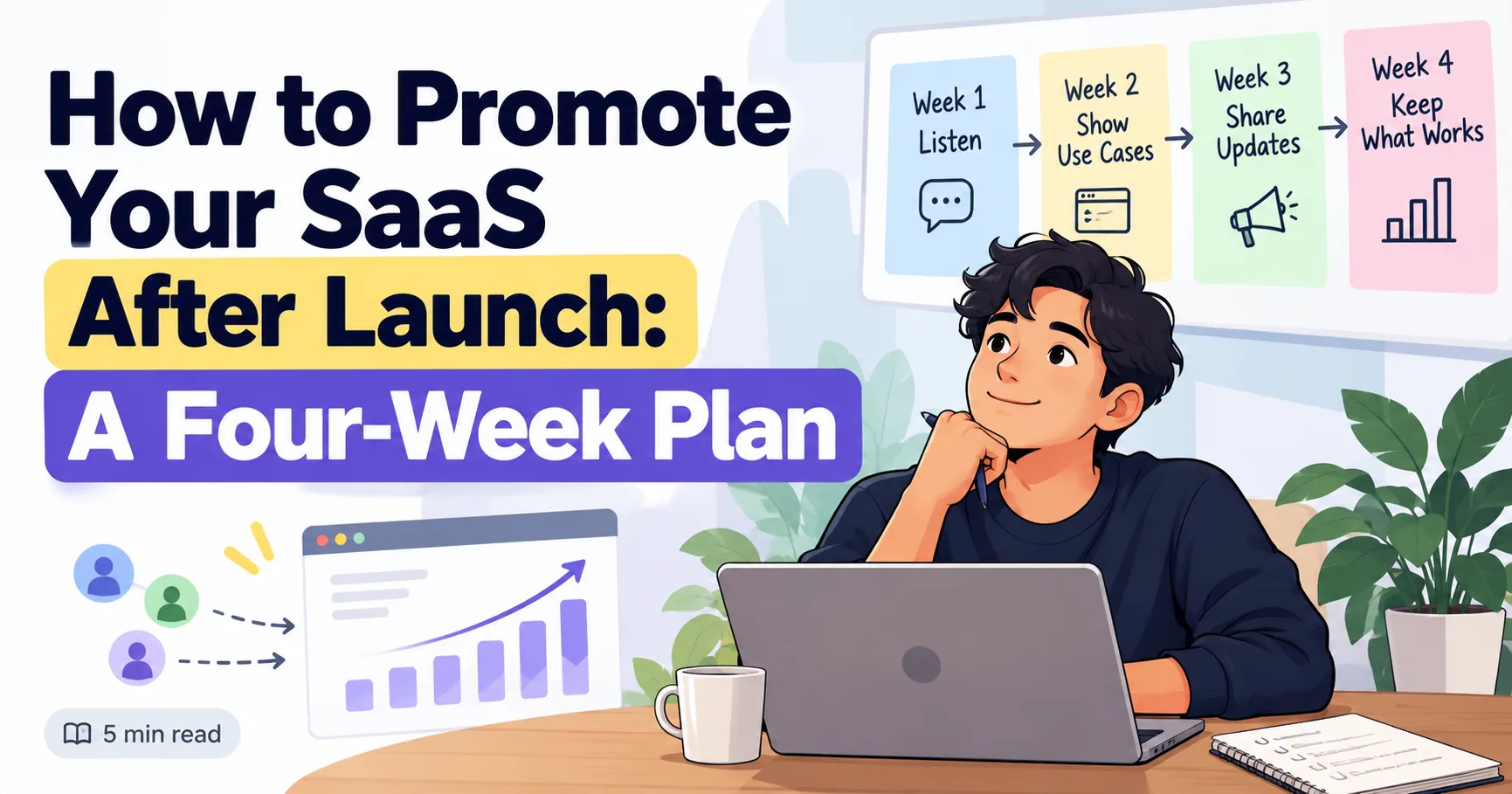
How to Promote Your SaaS After Launch: A Four-Week Plan
Launch day is over, but you still have things worth sharing. Use this four-week plan to reach the right people without posting the same pitch everywhere.
Oct 7, 20264 min read
On this page
- Week 1: Listen before writing another announcement
- Week 2: Show one real use of the product
- Week 3: Share a change you made from feedback
- Week 4: Keep the channels that brought the right people
- What should you post after launch?
- How often should you promote your SaaS?
- Do you need to pay for ads after launch?
You announced your SaaS. People saw the launch post. A few visited, and some may have signed up.
What do you share now?
You do not need to keep posting “We launched!” The next month gives you better things to talk about: a real use of the product, a question someone asked, a problem you fixed, or a lesson you learned.
Here is a four-week plan for promoting your SaaS after launch without turning every post into an ad.
Week 1: Listen before writing another announcement
Read the comments and questions from launch day. Look at support messages and watch where new users get stuck.
Write down the words people use to describe their problem. They may be clearer than the words on your landing page.
Then pick one question you can answer properly. If visitors keep asking whether your tool works for small teams, show how a small team would use it. If they ask what happens after signup, show the first screen.
Share that answer where the question came up. Make the answer useful even to someone who does not click your link.
Week 2: Show one real use of the product
A feature list tells people what is included. An example shows what they can do.
Choose one task your product handles well and walk through it:
- What problem does someone start with?
- What do they do in the product?
- What result do they get?
- Who would find that result useful?
Use a real screenshot or short recording if it helps. Be honest about the limits. If the feature is still early, say so.
You can turn this example into a blog post, a short social post, or an answer in a relevant community. Adjust it to the place you share it. Do not paste the same promotional message into every discussion.
Week 3: Share a change you made from feedback
By now, someone has probably pointed out a confusing step or asked for something you did not expect.
If you fixed it, explain the change in plain language:
“People could not tell what to do after creating an account, so we added a sample project and a clearer first step.”
That says more than “Huge update!”
Reply to the person who raised the issue. Tell existing users who opted in to product updates. If the change makes the product easier for new visitors to try, update your website and product listing too.
Only describe a change you actually made. You do not need to invent a customer story to make an update sound interesting.
Week 4: Keep the channels that brought the right people
Look back at where visitors came from and what they did after arriving.
A community that sent a small number of people who used the product may be more useful than a post that got many views and no meaningful activity. Look for questions, signups, first uses, and return visits, not just impressions.
Choose one or two places where you can continue contributing. That might be a community where your intended users ask questions, your own email list, a useful blog topic, or a directory that fits the product.
For more ideas on choosing places to list a startup, read Where to Submit Your Startup. Submit where the product belongs; a long list of irrelevant links is not a promotion plan.
What should you post after launch?
When you are unsure what to share, start with something you can show or explain honestly:
- A task someone can complete with the product
- An answer to a question new users keep asking
- A feature you improved and why
- A mistake you found and fixed
- A practical lesson from building the product
- A clear comparison between two ways to solve the problem
Each post should have a point beyond “visit my website.” The link can be there for someone who wants to learn more.
How often should you promote your SaaS?
There is no useful posting number for every product.
Share when you have a helpful example, an answer, or a real update. Reply when someone asks a question. Leave space to work on the product and talk to users privately.
If you have nothing new to say, do not manufacture an announcement. Use that time to learn why someone tried the product, why someone left, or what would make it more useful.
Do you need to pay for ads after launch?
Not necessarily. Before paying for more visitors, check whether people can understand and use the product when they arrive.
If visitors are interested but get stuck at signup, more traffic will bring more people to the same obstacle. Fix the path first. Paid promotion is a decision to test, not a required next step after launch.
Your launch gives you something to build on. Over the next four weeks, show people how the product works, answer their questions, share real improvements, and spend more time in places where your intended users already are.
That gives people a reason to come back—and gives you a better reason to speak than another launch announcement.
Launch your product on IndieNeed
Free to submit, hand-reviewed, and you pick the launch day.
Submit a productProducts to explore
Related articles
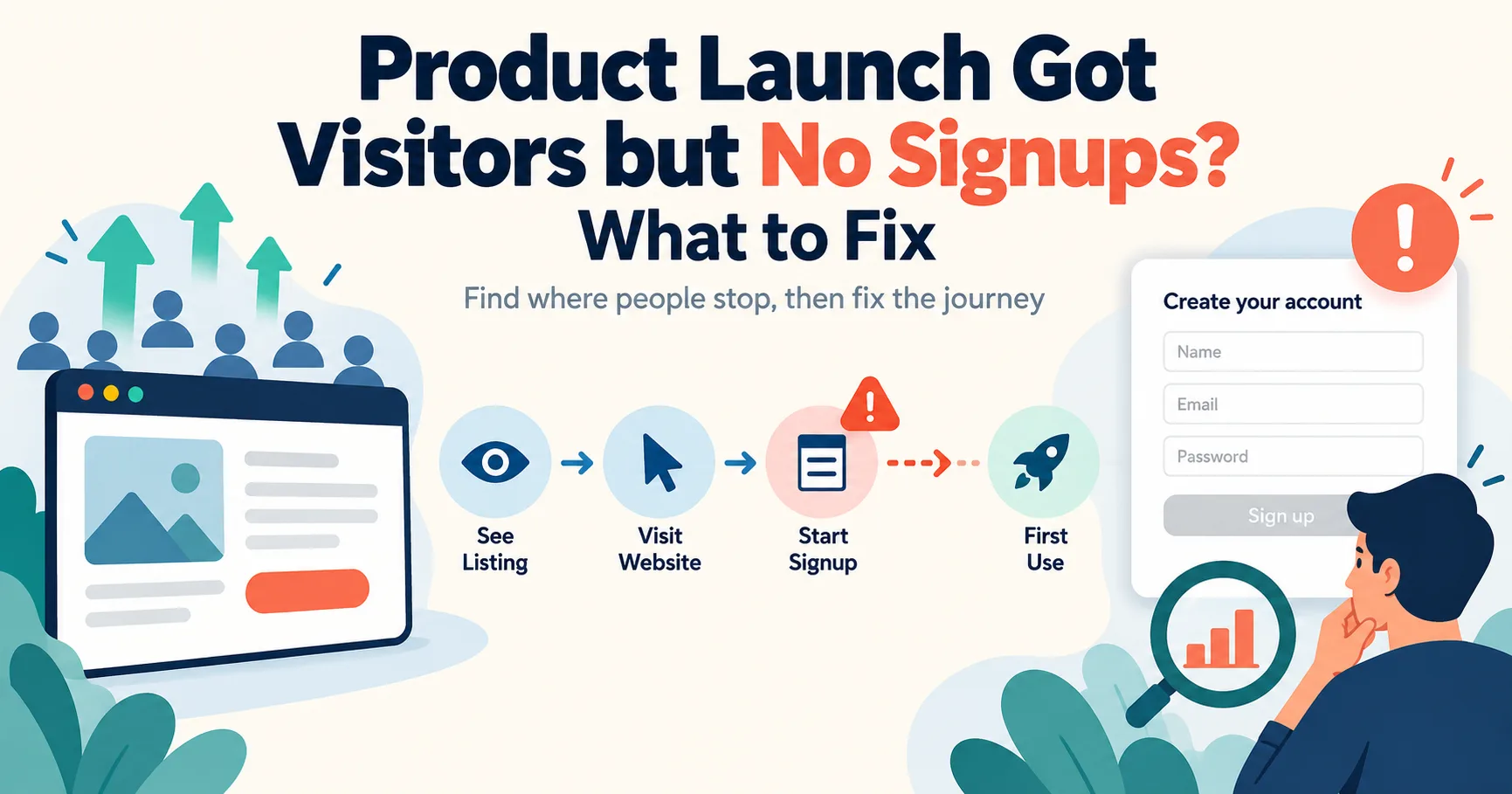
Product Launch Got Visitors but No Signups? What to Fix
People visited your launch page but did not sign up. Find where they stopped, then fix the part of the journey that is losing them.
Oct 6, 20265 min read
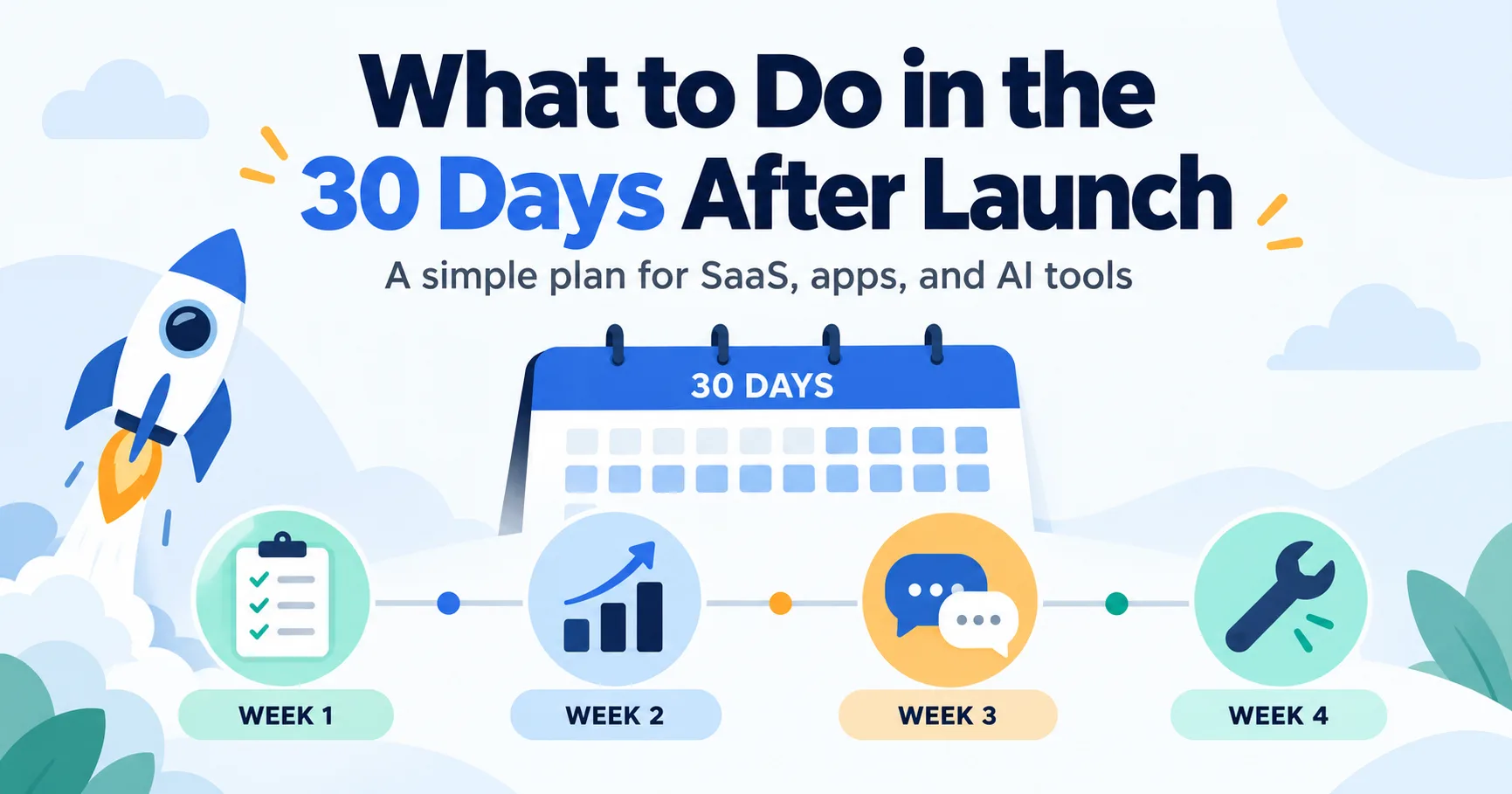
What to Do After Launching a Product: A 30-Day Plan
Your product is live. Here is what to check, measure, and improve during the first 30 days after launch.
Sep 28, 20265 min read
Where to Submit Your Startup in 2026
Most founders dump their product into 80 sites and hear nothing. Here is a one-week order that actually gets visitors, listings, and a few real backlinks.
Sep 20, 20269 min read