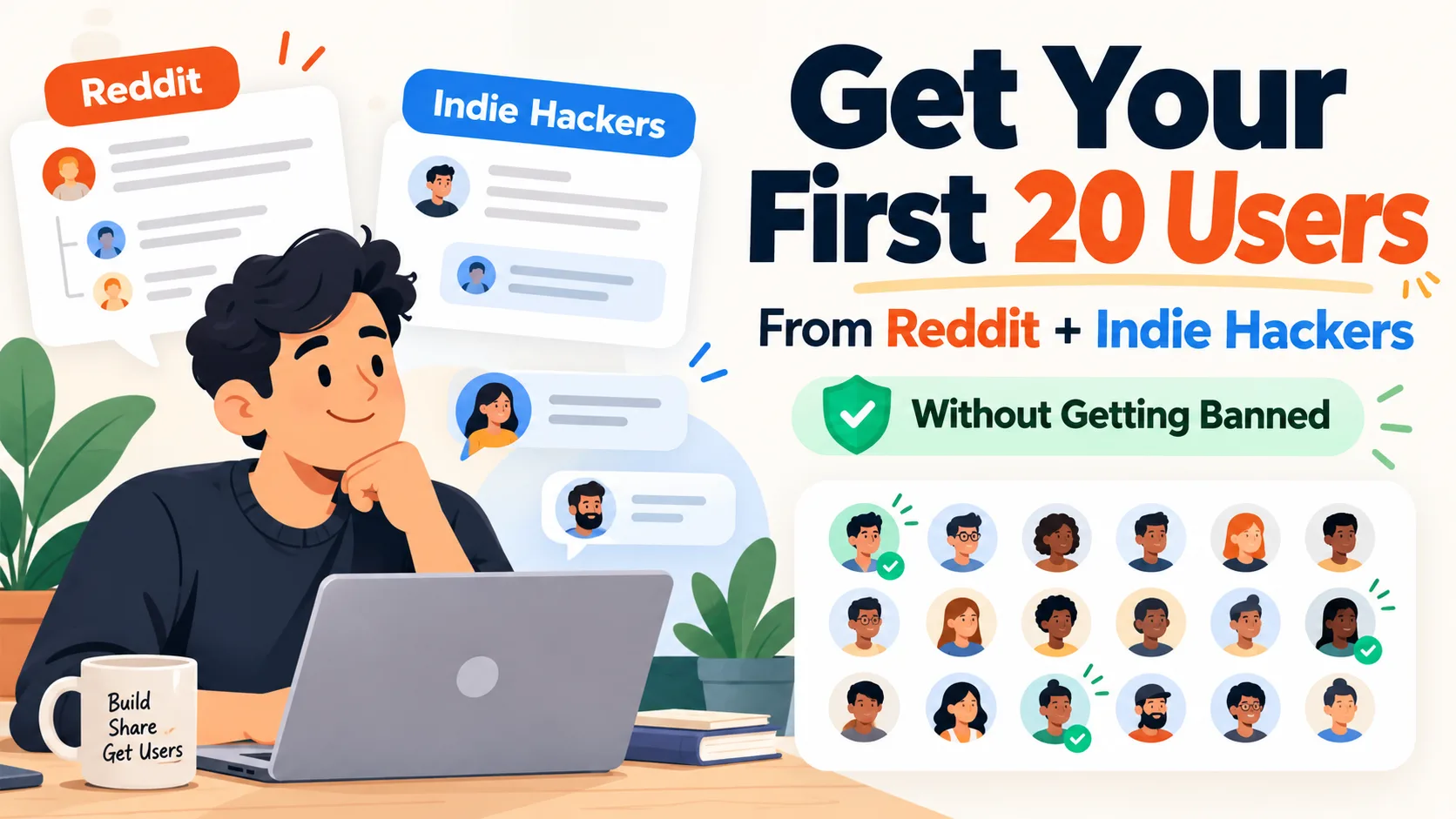
How Solo Founders Get Their First 20 Users on Reddit and Indie Hackers Without Getting Banned
Most early users for indie SaaS come from conversations, not launch days. This guide shows solo founders how to find the first 20 users and testers on Reddit and Indie Hackers by contributing first, following current rules, and asking for feedback instead of pitching.
Oct 10, 20267 min read
On this page
- How Solo Founders Get Their First 20 Users on Reddit and Indie Hackers Without Getting Banned
- Why the First 20 Matter More Than a Launch Spike
- Reddit: Find the Right Rooms and Contribute Before You Mention Anything
- Indie Hackers: Treat It as Ongoing Conversation, Not a One-Time Post
- Combining the Two Channels for the First 20
- Common Mistakes That Kill Early Traction
- What to Do With the First Users You Get
- Conclusion
- FAQs
How Solo Founders Get Their First 20 Users on Reddit and Indie Hackers Without Getting Banned
Most solo founders do not get their first useful users from a Product Hunt day. They get them by showing up in places where people already talk about the problem the product solves.
Reddit and Indie Hackers are two of the most reliable free places for this, provided you treat them as communities first and promotion channels second. The goal for the first 20 users is not traffic. It is a small group of people who will try the product, point out what is broken, and tell you whether the problem is real.
This guide focuses on the practical steps that work when you have no audience and limited time.
Why the First 20 Matter More Than a Launch Spike
A launch board can send visitors. Those visitors rarely stick around long enough to tell you what to fix. Early users who found you through a conversation are different. They already care about the problem. They will answer follow-up questions. They will notice when you ship the change they asked for.
IndieNeed’s own guide on getting your first 100 users covers the broader one-week sequence that includes listing the product. This article narrows in on the community work that usually comes before or alongside that listing. The two approaches complement each other: community conversations give you the feedback that makes a later listing stronger.
Reddit: Find the Right Rooms and Contribute Before You Mention Anything
Reddit works because people describe their problems in plain language. Search for the exact pain your product addresses rather than the product category. A founder building an invoicing tool for freelancers looks in r/freelance and r/smallbusiness for phrases like “client ghosted after invoice” or “chasing payments.” A founder building a developer tool looks in relevant language or framework communities.
Useful subreddits for early feedback and first users include:
- r/SideProject and r/microsaas for sharing what you built and asking for roast-level feedback.
- r/AlphaandBetaUsers when you specifically need testers.
- r/SaaS and r/IndieHackers for founder-to-founder discussion, with stricter limits on direct promotion.
Rules differ by community and change. Always read the sidebar and pinned posts before posting. Many communities expect most of your activity to be non-promotional. In practice this means answering questions, sharing relevant experience, and only mentioning your product when it directly helps someone who already asked for a solution.
A workable sequence:
- Spend one to two weeks reading and commenting. Answer questions you know. Do not drop links.
- Note the exact wording people use when they describe the problem. Save those phrases for your product description and outreach.
- When you post, lead with the problem and what you learned. Ask for specific feedback (“Is the onboarding step clear?”) rather than general praise.
- Disclose that you built it. Stay in the thread and reply to every comment.
- Prefer designated feedback or weekly threads when they exist. Standalone “I launched X” posts get removed in most larger communities.
One founder described getting the first handful of users by posting a feedback exchange request, then following up with the same people once the MVP was ready. The numbers were small, but the people who replied already understood the problem.
Avoid cold-DMing members of a subreddit. Most communities ban it. Public, relevant replies scale better and build a visible history that moderators can see.
Indie Hackers: Treat It as Ongoing Conversation, Not a One-Time Post
Indie Hackers is a founder community with product pages and discussion groups. It is slower than Reddit for raw volume and better for detailed feedback from people who have shipped products themselves.
The practical steps that surface in founder write-ups:
- Create a product page. It remains discoverable after any single post fades.
- Engage in existing threads before you post your own. Comment on milestones and share what you are learning.
- Post specific updates rather than generic “I launched” announcements. Titles that include a concrete change or number tend to get more replies.
- Ask narrow questions. “Would you pay $9 or $29 for this if the core workflow worked?” produces more useful answers than “What do you think?”
- Share small milestones publicly. Early users often appear in the comments on those posts.
Founders who treat Indie Hackers as a place to document the build and the mistakes consistently report higher-quality conversations than one-off launch posts. The users who show up are more likely to stay long enough to give real feedback.
Combining the Two Channels for the First 20
A simple weekly rhythm that fits around building:
- Three to five short, useful comments on Reddit in the right subreddits.
- One or two replies or a short update on Indie Hackers.
- One personal outreach message to someone who publicly described the exact problem you solve (from a public post, not a cold list).
- Keep a short note of who replied and what they said. The first 5–10 people who engage are usually the ones worth inviting into a private feedback loop.
Track only two things at this stage: whether people complete the core action in your product, and what specific friction they mention. Vanity metrics such as total visitors matter less than whether the people who tried it could finish the job they came to do.
Once you have a few people who have used the product and given feedback, list it on a lasting directory so others can find it later. IndieNeed keeps product pages live after launch day and is built for indie SaaS and AI tools. You can submit a free listing that is reviewed before it goes live, or review the startup directories guide for other places that fit different stages. The community work and the listing serve different jobs: conversations give you signal; a stable listing gives people a place to return.
Common Mistakes That Kill Early Traction
Posting a link with no context. Most communities remove these immediately.
Treating every reply as a chance to pitch. People notice, and the account history becomes promotional.
Skipping the reading phase. The language and the norms of a community are visible in the existing posts. Ignoring them makes every later post less effective.
Asking for users before the product can be tried. Early feedback is more useful when someone can click through a working flow, even if it is rough.
Expecting a single post to produce dozens of users. The realistic path is a series of small, relevant interactions that compound.
What to Do With the First Users You Get
Reply quickly. Fix the small thing they flagged and tell them you did. Ask one follow-up question about the part of the workflow that still feels unclear. Offer a short call or async Loom if they are willing. These people become the references you can cite later and the source of the language that improves your listing and your outreach.
For more on turning early feedback into reviews, see IndieNeed’s guide on asking users for honest product reviews. For the sequence after you have something public, the four-week promotion plan and the 30-day post-launch checklist cover the next steps without repeating the same pitch.
Conclusion
The first 20 users for most solo-founded SaaS products come from consistent, low-volume participation in the communities where the problem is already being discussed. Reddit gives you volume and raw language. Indie Hackers gives you higher-quality feedback from other builders. Both require you to contribute before you ask.
Start with one week of reading and useful comments. Post one specific feedback request. Follow up with the people who reply. List the product on a lasting directory once you have something people can actually try. The combination produces slower numbers than a big launch day and more useful signal.
If you are ready to put a public page around the product while you keep talking to early users, submit it on IndieNeed and keep the conversation going in the places your customers already are.
FAQs
How long does it usually take to get the first 10 users this way?
Most founders who stay consistent see the first handful within two to four weeks. The exact number depends on how specific the problem is and how actively you reply.
Can I post in r/SaaS about my product?
Check the current rules. Promotion is limited and usually requires disclosure and relevance. Many founders get better results by answering existing questions than by creating new promotional posts.
Should I use Indie Hackers or Reddit first?
Use both at low volume. Reddit for discovering language and finding people who already described the problem. Indie Hackers for ongoing milestone posts and product-page visibility.
Do I need an existing audience?
No. These channels work because the audience is already there. Your job is to join the conversation that is already happening.
Launch your product on IndieNeed
Free to submit, hand-reviewed, and you pick the launch day.
Submit a product