How to Get Your First 100 Users for Your Indie Product
Your product works — but nobody knows it exists. Here's the exact one-week playbook indie makers use to go from zero to their first 100 users.
Aug 14, 20266 min read
On this page
- Why the first 100 users matter more than the next 10,000
- Step 1: Nail your one-sentence pitch
- Step 2: Launch where makers already gather
- Step 3: Write a launch post people actually read
- Step 4: Do things that don't scale
- Reach out personally
- Answer every question yourself
- Turn users into fans
- Step 5: Stack small channels
- Step 6: Measure what matters
- Your one-week launch checklist
- Ready to get your first hundred?
You built something. It works. You're proud of it. And then you hit the hardest wall in all of indie hacking: nobody knows it exists.
Getting your first 100 users is a completely different game from getting your next 10,000. At the start you have no audience, no reviews, no social proof, and no budget to buy attention. The good news? You don't need any of those. You need a plan, a few hours, and the willingness to put your product in front of real people.
Here's the exact playbook indie makers use to go from zero to their first hundred users — and how to do it in a single focused week.
Why the first 100 users matter more than the next 10,000
Your first hundred users aren't about revenue. They're about signal. They tell you whether people actually want what you built, which features matter, and how to describe your product in words that click. Every successful indie product started as a scrappy launch to a tiny audience that gave honest feedback.
The goal of your first launch isn't to go viral. It's to find ten people who genuinely need your product — then a hundred more who look just like them.
Treat these early users as collaborators, not customers. They'll forgive rough edges if you listen and ship fast.
Step 1: Nail your one-sentence pitch
Before you tell anyone about your product, you need to explain it in one sentence a stranger understands. If people don't get it in five seconds, they scroll past.
Use this format:
[Product] helps [who] do [outcome] without [pain].
For example: "CastReader reads and explains any webpage, Kindle, or PDF out loud, so you can learn on the go without staring at a screen."
Write ten versions. Read them out loud. Keep the one that makes someone say "oh, I need that." This single sentence becomes your tagline everywhere — your launch listing, your social posts, your homepage.
Step 2: Launch where makers already gather
The slowest way to get users is to build an audience from scratch. The fastest is to borrow one — post where people are already looking for new products to try.
A good launch platform gives you three things you can't get alone:
- A built-in audience of early adopters who came specifically to discover new products
- A dofollow backlink that boosts your own site's SEO for months
- Social proof — upvotes, reviews, and comments you can screenshot and reuse everywhere
This is exactly what Indie Need is built for. You submit your product, pick a launch day, and get in front of makers, founders, and early adopters who are actively hunting for the next useful tool.
Submit your product on Indie Need → — it's free, hand-reviewed, and takes about two minutes.
Step 3: Write a launch post people actually read
Most launches fail because the copy is boring. Don't list features. Tell a tiny story:
- What problem you kept hitting (the reason you built this)
- What you tried before that didn't work
- What your product does differently in one clear line
- What you want from readers — a try, a comment, honest feedback
Keep it short. Add one screenshot or a 30-second demo video. People decide in seconds whether to click, so lead with your best line and your best visual.
Step 4: Do things that don't scale
Paul Graham's famous advice is still the best-kept secret of early growth: do things that don't scale. For your first 100 users, that means going one-to-one.
Reach out personally
Message 20 people who fit your ideal user — in relevant communities, DMs, or email. Don't pitch. Ask: "I built a thing that solves [problem]. Would you be up for trying it and telling me what's confusing?" People love being asked for their opinion.
Answer every question yourself
When someone comments or reviews, reply within the hour, personally. Early users remember a founder who cared. Those replies turn into testimonials, word-of-mouth, and repeat visitors.
Turn users into fans
Follow up after a few days. Ask what almost stopped them from using it. Fix that thing. Then ask if they'd share it with one person who'd find it useful. One genuine fan is worth a hundred passive signups.
Step 5: Stack small channels
You won't find 100 users in one place. You'll find 10 here, 15 there. Work several small channels in the same week so the momentum compounds:
- Launch platforms — submit to Indie Need and other maker communities
- Niche communities — subreddits, Discords, and forums where your users already hang out (contribute first, then share)
- Your network — a personal note to friends, past colleagues, and anyone who'd care
- Build in public — post your launch, your numbers, and your lessons; makers love rooting for other makers
- SEO from day one — a clear product page and a backlink or two start compounding immediately
No single channel needs to be huge. Five channels that each bring 20 users get you to 100.
Step 6: Measure what matters
Vanity metrics feel good and teach you nothing. In the first week, watch just three things:
- Activation — did new users reach the "aha" moment, or drop off first?
- Feedback quality — are people confused about the same thing repeatedly? Fix it.
- Word of mouth — is anyone sharing it without you asking? That's product-market fit whispering.
If activation is low, your onboarding is the problem, not your marketing. Fix the product before you pour more traffic in.
Your one-week launch checklist
Here's the whole plan on one page:
- Day 1 — Write your one-sentence pitch and a short launch post
- Day 2 — Take one clean screenshot and record a 30-second demo
- Day 3 — Submit your product to Indie Need and schedule your launch
- Day 4 — Personally message 20 ideal users
- Day 5 — Launch day: post everywhere, reply to every comment within the hour
- Day 6 — Follow up with early users, gather feedback, fix the top confusion
- Day 7 — Ask your happiest users to share with one friend
Do this and 100 users is not a moonshot — it's a checklist.
Ready to get your first hundred?
Your product doesn't get discovered by accident. It gets discovered because you put it somewhere people are looking, told a clear story, and showed up for your early users.
Indie Need is the fastest place to start: a community of makers and early adopters, a free hand-reviewed listing, real upvotes and reviews, and a dofollow backlink that keeps working long after launch day.
Create your free account → and submit your product →. Your first 100 users are closer than you think.
Launch your product on IndieNeed
Free to submit, hand-reviewed, and you pick the launch day.
Submit a productProducts to explore
Related articles
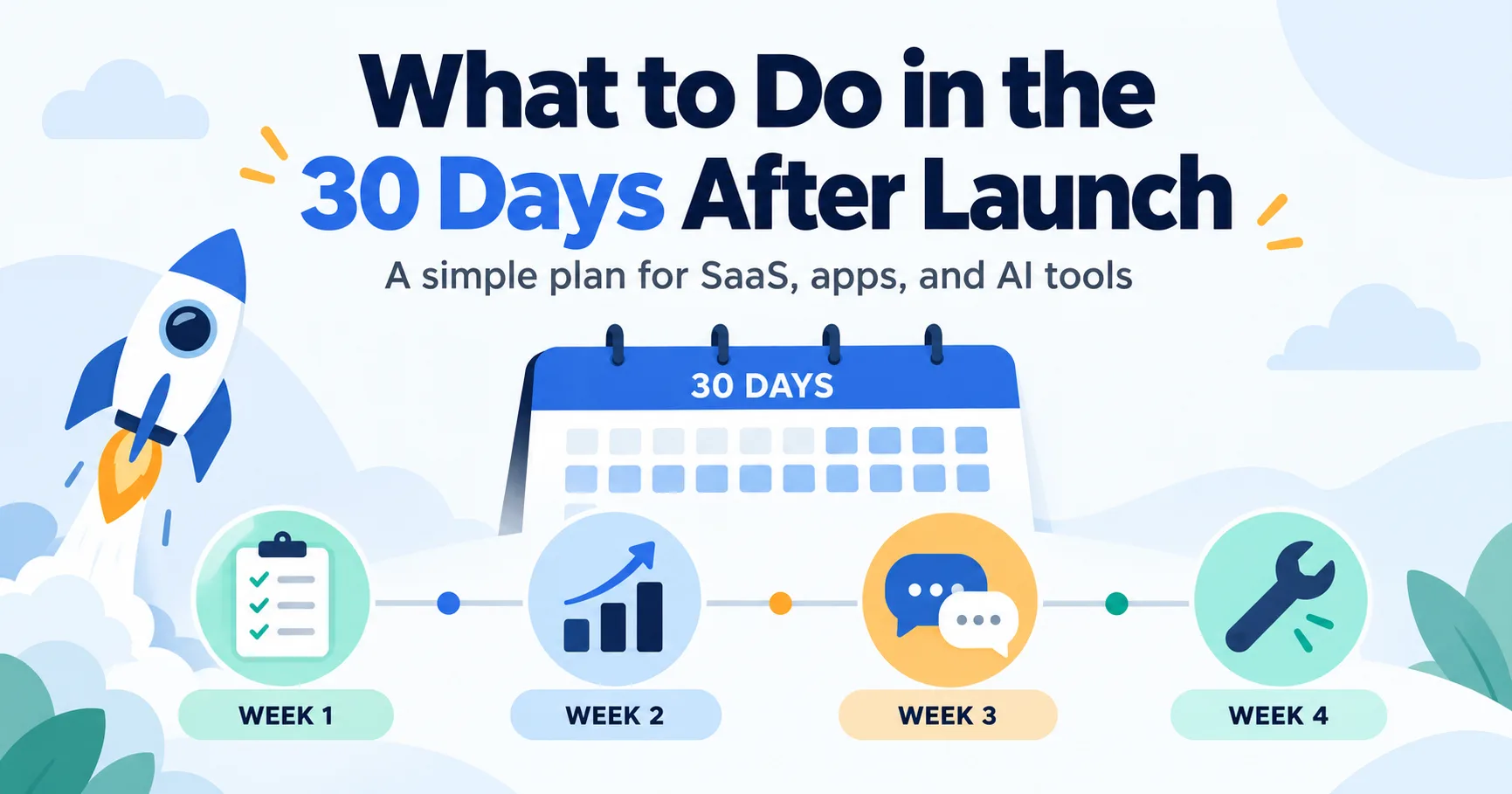
What to Do After Launching a Product: A 30-Day Plan
Your product is live. Here is what to check, measure, and improve during the first 30 days after launch.
Sep 28, 20265 min read
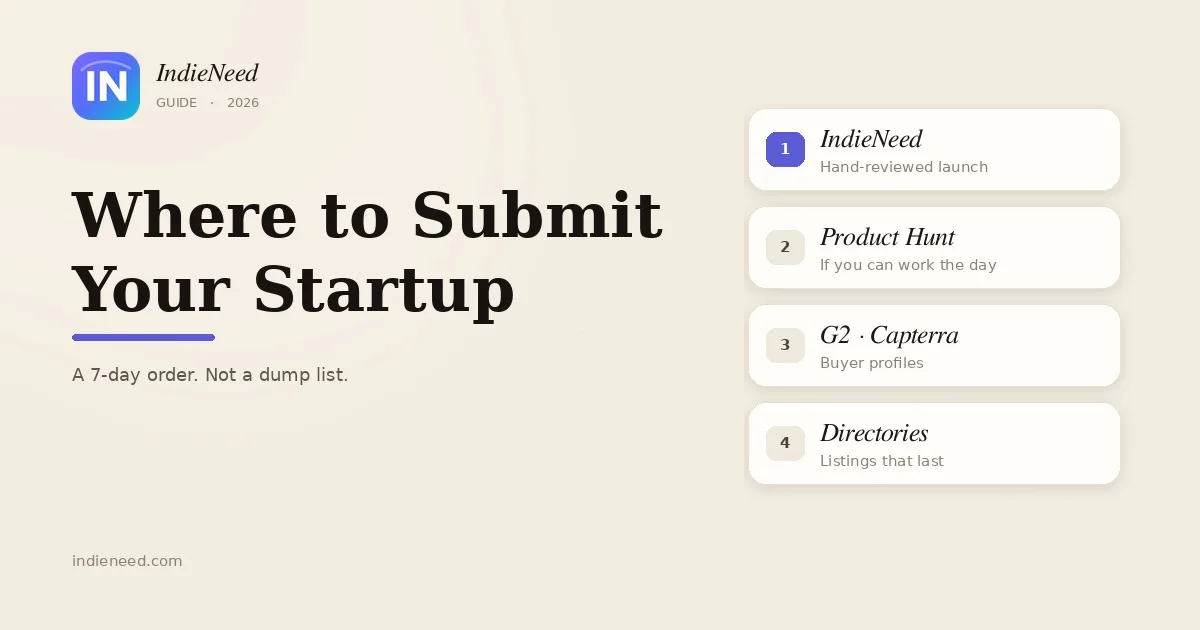
Where to Submit Your Startup in 2026
Most founders dump their product into 80 sites and hear nothing. Here is a one-week order that actually gets visitors, listings, and a few real backlinks.
Sep 20, 20269 min read
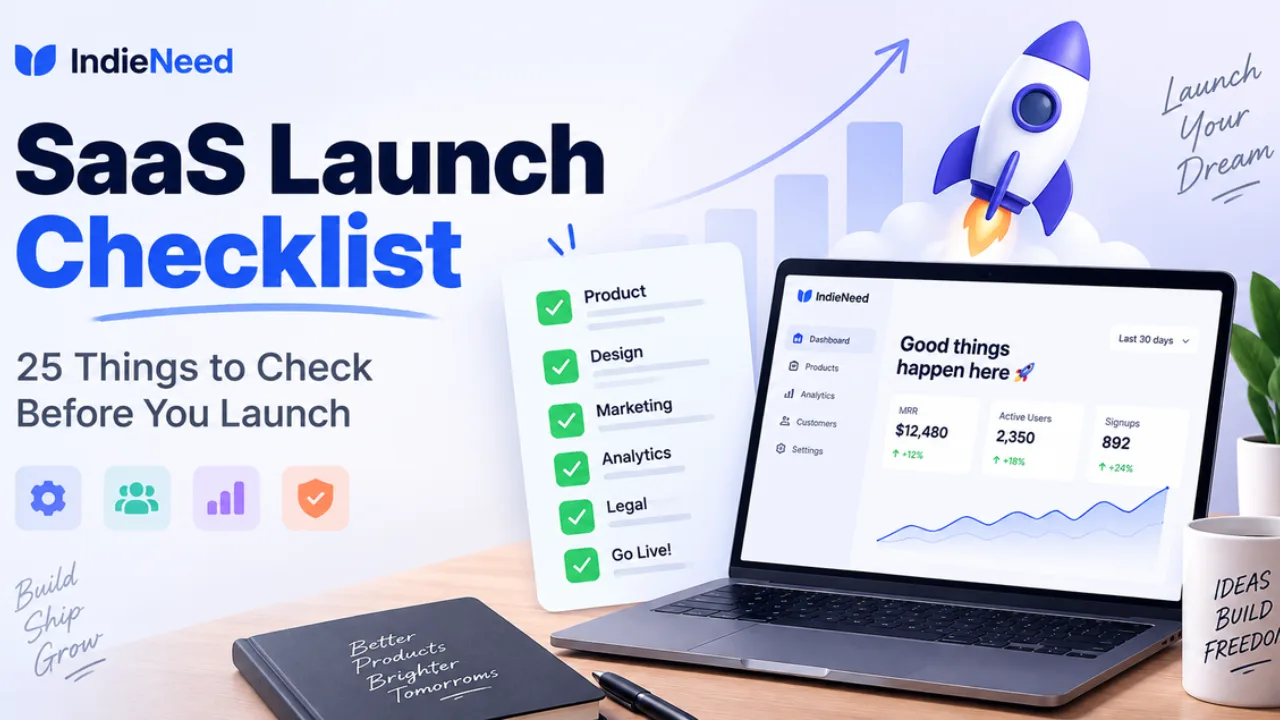
SaaS Launch Checklist: 25 Things to Check Before You Launch
A simple SaaS launch checklist for founders covering everything worth checking before, during and after launch day.
Sep 15, 202611 min read