What Google's AI Search Guidance Means for Your SaaS Site: AEO, GEO and llms.txt
Google's May 2026 AI search guide says AEO and GEO are still SEO. Keep indexing and useful pages, skip llms.txt for Google rankings, and measure with Search Console.
From the IndieNeed blog: guides for indie makers launching a product.
8 min read

On this page
- At a glance
- What Google actually published
- AEO, GEO, and SEO in plain words
- Keep / stop / ignore checklist for a small SaaS
- Keep
- Stop (or do not start)
- Ignore for Google Search (harmless, not helpful there)
- llms.txt specifically
- FAQ schema after May 2026
- How to measure AI Overviews and AI Mode in Search Console
- Common mistakes and their fixes
- Practical next steps for a small SaaS this weekend
- Bottom line
Quick answer: Google's May 2026 AI search guidance says optimizing for AI Overviews and AI Mode is still SEO. Keep indexing, clear pages, and people-first content. Skip llms.txt and special AI markup for Google Search. They neither help nor hurt rankings there. Measure results in Search Console's Generative AI performance report.
Google published a guide to optimizing for AI features in Search in May 2026, then clarified llms.txt and FAQ rich results. Founders ask the same things: do I need a new "AEO" stack, should I add llms.txt, and is FAQ schema dead?
This piece turns those docs into a keep / stop / ignore checklist for a small SaaS site. It is not an indexing primer. If your pages are not in Google yet, start with why your startup is not showing on Google.
At a glance
| Question | Short answer |
|---|---|
| Is AEO or GEO a new discipline? | Google says it is still SEO |
| Do I need llms.txt for Google? | No. Google Search does not use it |
| Does FAQ schema still unlock FAQ rich results? | No. Those rich results stopped appearing in May 2026 |
| What still matters most? | Indexed, snippet-eligible pages with useful, unique content |
| How do I measure AI Search traffic? | Generative AI performance report in Search Console |
| Should I rewrite everything "for AI"? | No. Focus on people-first pages |
What Google actually published
On May 15, 2026, Google Search Central announced the resource. The long-form guidance is the AI optimization guide. Related pages cover AI features appearance and Search updates.
The core claim is simple. Generative AI features in Search are rooted in the same ranking and quality systems as classic results. Retrieval-augmented generation and query fan-out pull from content that already does well for people.
Later clarifications that matter for founders:
- June 15, 2026: Google Search does not use llms.txt for ranking or inclusion in generative AI features
- May 7, 2026: FAQ rich results stopped appearing in Google Search
- June 15, 2026: FAQ rich-result documentation removed
Prefer those primary docs over secondary recaps when you decide what to build.
AEO, GEO, and SEO in plain words
| Term | What people mean by it | What Google says |
|---|---|---|
| SEO | Helping your site appear and perform in Search | Still the right frame |
| AEO | Answer engine optimization | Still SEO for generative AI search |
| GEO | Generative engine optimization | Still SEO for generative AI search |
You do not need a separate playbook or "AI SEO" rewrite because the SERP shows an AI Overview or AI Mode answer. Same fundamentals: useful content, crawlable pages, and a site people can trust.
If a vendor sells "AEO packages" that skip indexing or promise guaranteed AI Overview citations, compare the pitch to Google's ignore list below.
Keep / stop / ignore checklist for a small SaaS
Verified against Google's AI optimization guide and AI features docs as of 2026-11-06.
Keep
| Action | Why |
|---|---|
| Important URLs indexed and snippet-eligible | No extra technical requirements beyond that for AI features |
| Unique, people-first pages with a clear point of view | Generative features pull from quality content, not commodity rewrites |
| Clear headings; images or video when they help | Easier for people and for snippets / AI answers |
| Crawlable site, solid internal links, semantic HTML | Same as classic SEO; fix obvious JavaScript SEO issues |
| Improve weak page experience; cut near-duplicates | Listed among best practices; reduces scaled-content risk |
| Structured data that matches visible text (for rich results overall) | Not required for generative AI; still useful elsewhere in Search |
| Watch the Generative AI performance report in Search Console | Official way to see generative AI feature performance |
Stop (or do not start)
| Action | Why |
|---|---|
| A separate thin page for every query variation | Scaled content made primarily to manipulate rankings |
| Rewriting pages only so an AI system can "digest" them | Rewriting just for AI is not useful for Search |
| Chasing inauthentic mentions or citation farms | Fake mentions do not help |
| Treating structured data as a magic AI ranking lever | Overfocusing on it is on Google's ignore list for generative AI search |
| Blocking Googlebot while hoping for AI Overviews | Uncrawlable pages cannot appear |
Ignore for Google Search (harmless, not helpful there)
| Thing | Google's position |
|---|---|
| llms.txt | Google Search does not use it. Neither helps nor hurts Google rankings. Fine for other systems |
| Special "AI-only" markup for Search | Not used by Google Search for generative AI features |
| Content chunking schemes aimed only at AI | Not a Google Search requirement |
| Panic that FAQPage markup itself will tank you | Unused structured data does not cause problems; the FAQ rich result feature is what went away |
Controls that do matter: robots.txt for Googlebot, snippet limits (nosnippet / data-nosnippet / max-snippet / noindex), and Google-Extended for some other systems' training or grounding. Those are separate from llms.txt. See the AI features appearance docs.
llms.txt specifically
llms.txt is a proposed site file meant to help some AI systems find your content. Founders hear about it next to robots.txt and assume Google needs one too.
Google's position, clarified in the AI optimization guide (including the June 15, 2026 note):
- Google Search does not use llms.txt
- Having one does not help your Google rankings
- Having one does not hurt your Google rankings
- You may still publish one if other tools or agents you care about use it
For Google Search alone: optional, not a ranking lever. Do not delay real content or indexing work for an llms.txt file.
FAQ schema after May 2026
| Date | What changed |
|---|---|
| May 7, 2026 | FAQ rich results no longer appear in Google Search |
| June 15, 2026 | FAQ documentation removed from Search Central |
In practice:
- You will not get the old FAQ rich-result presentation in Google Search
- Leaving FAQPage markup is fine if it matches visible content; unused structured data is not treated as a problem
- Do not invent FAQ blocks just for schema theater
- Real Q&A on the page can still help humans. That is content quality, not a rich-result trick
If your only FAQ strategy was chasing the rich result, retire that goal. Keep genuine answers on pricing, limits, and setup pages instead.
How to measure AI Overviews and AI Mode in Search Console
Google points site owners to the Generative AI performance report in Search Console. Use it to see how your site appears in generative AI features, rather than guessing from screenshots or third-party tools alone.
Practical habits for a small SaaS:
- Confirm the property is verified and important URLs are indexed.
- Open the Generative AI performance report weekly.
- Pair it with the classic performance report for clicks, queries, and pages outside AI features.
- Check eligibility cues for Search generative AI features where Search Console surfaces them.
- Fix crawl, index, and content issues before chasing citations.
Agentic experiences appear in Google's guidance as an emerging area. Treat them as optional until they clearly matter for your category.
Common mistakes and their fixes
| Mistake | Fix |
|---|---|
| Building an "AEO site" separate from SEO | Follow the AI optimization guide as SEO with AI features in mind |
| Adding llms.txt and calling the AI project done | Ship useful pages; treat llms.txt as optional for non-Google systems |
| Mass-producing near-duplicate posts for every long-tail query | Write fewer, stronger pages with a real point of view |
| Leaving important docs behind login or blocked to Googlebot | Make public answers crawlable and indexable |
| Dropping FAQ content because the rich result died | Keep helpful answers; stop expecting the old rich-result UI |
| Ignoring Search Console after shipping content | Use the Generative AI report plus classic Search metrics |
| Paying for citation schemes or fake mentions | Earn real coverage; skip inauthentic mention hunting |
Practical next steps for a small SaaS this weekend
- Pick your 5–10 money pages (home, pricing, docs hub, main use-case pages).
- Confirm each is indexed and returns a useful snippet for its title or brand + topic.
- Cut or merge thin duplicates that exist only as keyword variants.
- Tighten headings and add one concrete example where a page is vague.
- Leave matching FAQPage markup alone; invent none for vanity. Skip llms.txt unless another system you use asks for it.
- Bookmark Search Console's Generative AI performance report.
- Fold leftover hygiene into your SaaS launch checklist. When the product page is ready for directories, submit it on IndieNeed.
Bottom line
Google's AI search guidance is not a call to rebuild your site for machines. Generative AI features sit on top of the same Search systems that already reward clear, crawlable, people-first pages.
Keep indexing and usefulness. Stop scaled thin pages and AI-only rewrites. Ignore llms.txt as a Google ranking tactic. Measure with Search Console, then spend the weekend on the pages that actually sell your product.
Launch your product on IndieNeed
Free to submit, hand-reviewed, and you pick the launch day.
Submit a productProducts to explore
Related articles

How to Price Your First SaaS Product When You Have No Customers Yet
No users, no data, no idea what to charge? Set a cost floor, a value ceiling and a reference range, then launch one plan and learn from real payments.
8 min read
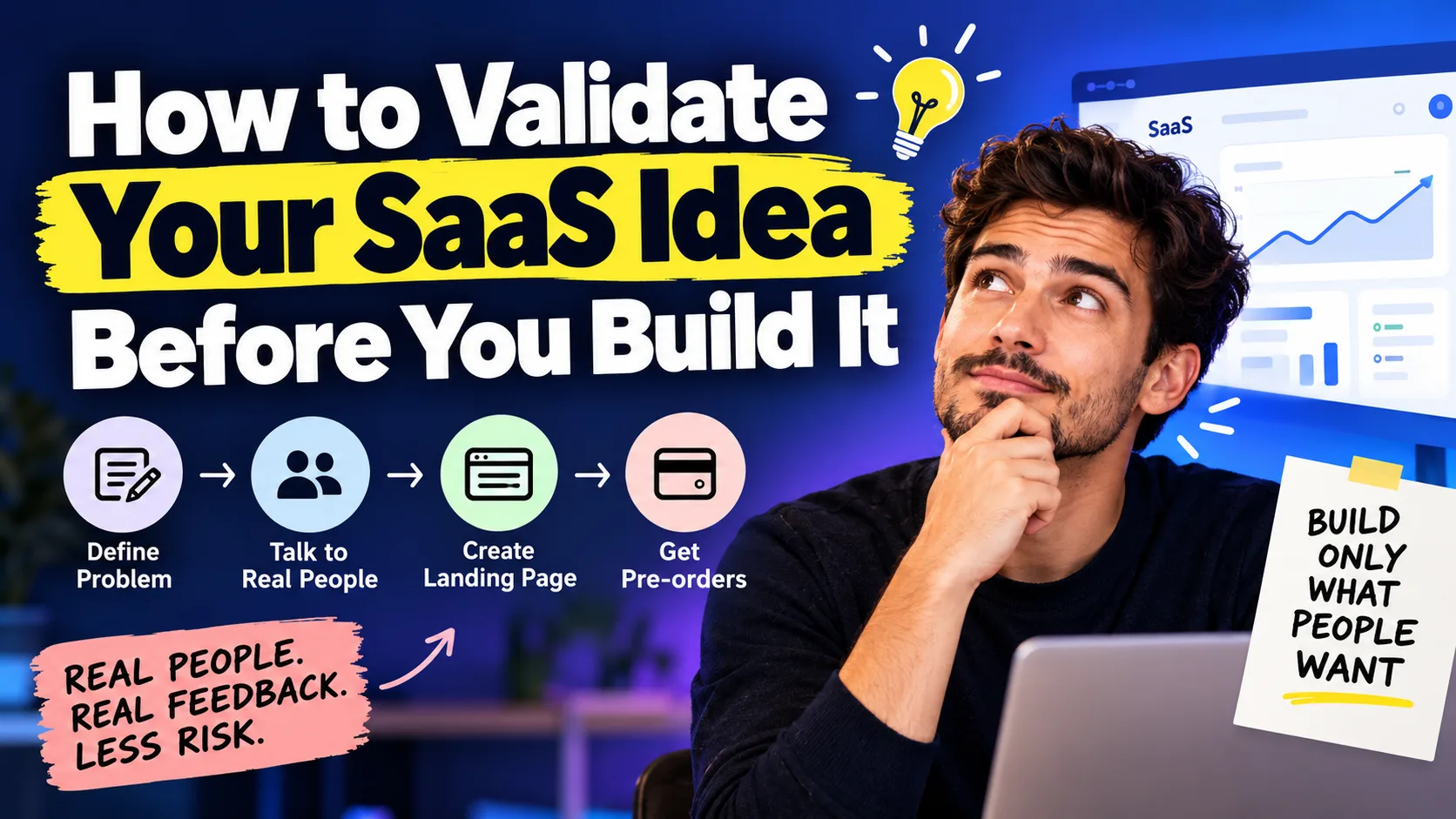
How to Validate Your SaaS Idea Before You Build It
Before you spend months building, spend two weeks finding out if people actually want it. A simple, step-by-step way to test your SaaS idea with real people.
8 min read
How to Launch an AI Tool in 2026: A Step-by-Step Plan
AI tools launch into a crowded market. Here is how to prepare the product page, where to list it, and how to run launch week so people actually try it.
5 min read