Market Verdict: Check If Your Business Idea Holds Up Before You Commit
Market Verdict scores your business idea from 0 to 100 using real economics and local competitor data. Here's how it works and costs.
Sponsored. The maker paid for this post as part of their IndieNeed launch. Links to their product are marked sponsored.
By IndieNeedPublished Updated 9 min read
On this page
- What Market Verdict does
- Ways to start
- Walking through the full analysis
- What happens behind the scenes
- What each part of the report means
- Reading the score: the yoga studio sample
- Practical ways to use it
- Why not just ask a chatbot?
- Limits worth knowing
- Privacy and your data
- Languages
- Pricing
- Quick FAQ
- Who it's for
Most business ideas sound good in your head. The harder part is finding out whether the numbers hold up before you sign a lease, quit a job, or spend your savings. Market Verdict is a small tool built for that one job: it gives your idea a viability score from 0 to 100 and shows you the reasoning behind it.
This guide covers what it does, how to use it, how to read the results, where it stops, and what it costs.
What Market Verdict does
You give Market Verdict a business type, a location, and a few basic economics. It returns a viability score, along with revenue and profit ranges, a break-even estimate in months, and the main risks it found.
The idea is simple. Instead of guessing whether a coffee cart or a bakery could work, you run it through the same math every time and get an answer you can compare against other ideas.
The site lists examples of the kinds of ideas people check:
- A Thai restaurant in Los Angeles
- An online coaching business
- A coffee cart near a transit stop
- An artisan bakery in London
- A ramen restaurant in Tokyo
- A language school in São Paulo
Ways to start
There are a few ways in, depending on how much you want to commit.
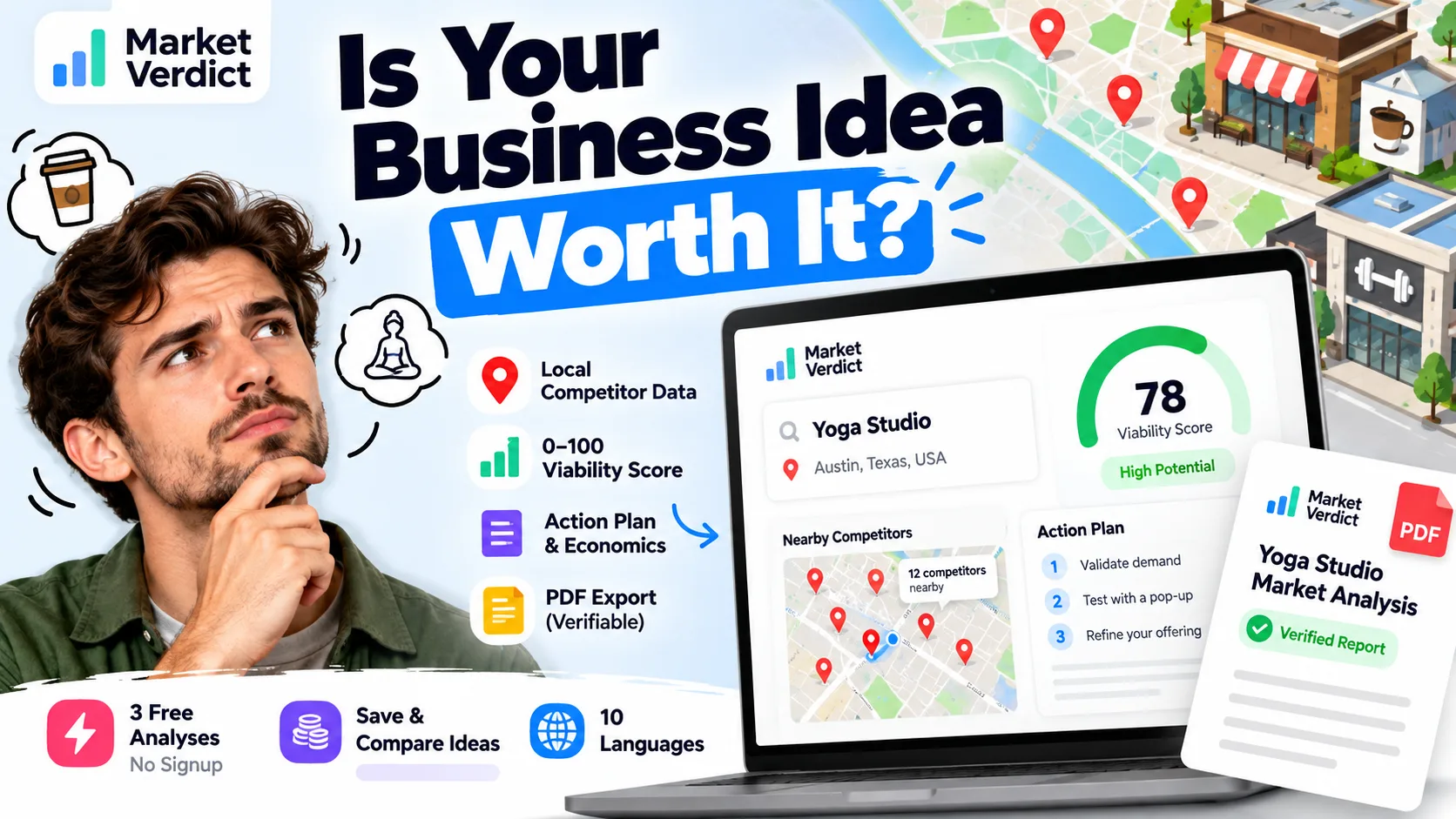
- The demo. Enter your idea and location and you get a viability score, a competition snapshot, and a market signal. The site says no signup is needed to see your score.
- Chat demo. You answer two quick questions, your business idea and where, by typing or speaking.
- The full analysis. A five-step form that collects your idea and economics and produces the complete report. New users get three free analyses.
If you just want a feel for it, the demo or chat demo is the quickest option. If you want numbers you can save, compare, and export, use the full analysis.
Walking through the full analysis
The homepage form takes you through five steps. The first step asks for two things:
- Business type, written in your own words, such as "Coffee cart near a train station"
- Mode, meaning how customers buy from you: Brick & Mortar, Online, or Hybrid
The mode matters because the site handles saturation differently for each. For a location-based business, it looks at how many competitors are nearby. For an online business, it looks at how crowded the niche is.
The later steps gather your location and your core economics. According to the methodology page, those are your pricing, expected volume, gross margin, and fixed costs. The use-cases page also mentions things like ticket size, customers per day, and startup cost as inputs that shape the revenue and break-even numbers.
It is worth taking a few minutes to get these numbers roughly right. The score can only be as good as the assumptions you feed it.
What happens behind the scenes
Market Verdict runs every analysis through the same model. The site is clear that the same inputs always produce the same scoring behaviour, so two ideas are compared on equal terms rather than on how well each one was described.
There are three parts:
- Your inputs frame the analysis: what you sell, where, at what price, and at what cost.
- Market signals come from public map data. The location is geocoded using LocationIQ, and nearby competitors are counted using Geoapify. The site says it does not buy proprietary datasets or scrape private sources.
- Scoring combines the economics and the market signals using a fixed rubric. That produces the score, the ranges, the break-even months, and the risk factors.
The math also uses country-level GDP and cost benchmarks, so the same idea can come out differently in different countries. According to the FAQ, results arrive in about a minute.
What each part of the report means
Here is how to think about each output.
Viability score (0–100). This is the headline number. Because the rubric is fixed and written down, it is meant for comparing one idea with another, or one version of an idea with another. The site describes the score as something you can argue with rather than take on faith.
Revenue and profit ranges. These are estimates of monthly revenue and monthly profit based on your inputs and the country benchmarks. They are shown as ranges, not single promises.
Break-even months. This is a specific month count rather than a vague "one to three years." It tells you roughly how much runway you would need before the business pays for itself.
Risk factors. These name the specific traps for your type of business. The site gives examples such as thin margins in food, overhead-heavy retail, and locations that look good but don't convert.
Action plan. These are practical next steps to test demand quickly. It comes with the paid plans, not the free one.
Reading the score: the yoga studio sample
The homepage shows a sample result: a yoga studio in Denver that scored 49.
The site doesn't break that sample down any further, so treat it for what it is: an example of the kind of answer you get. You get a number on a scale, not a pep talk and not a simple yes. Elsewhere, the site describes the result as a clear yes, maybe, or no.
A score on its own is less useful than the reasons behind it. When you get yours, look at the ranges, the break-even months, and the named risks. These show what is pulling the number up or down, and what would need to change.
If you want to see complete reports before trying it yourself, the samples page has downloadable PDF and TXT examples in several languages. It includes samples of the full paid analysis, which has an extra tailored section.
Practical ways to use it
Compare cities. You can re-run the same idea for each city you are considering and compare the results honestly, instead of assuming your home town is the best choice. Location changes things like income levels, competitor density, and costs.
Test your own assumptions. Each idea you check is saved along with your latest score. Every time you run it, the full inputs and results are saved as a separate verdict linked to that idea. You can change your price or expected volume, run it again, and see how the outcome moves.
Compare different ideas. Because every idea goes through the same rubric, you can line up a café, a studio, and an online service and see which holds up best on the same terms.
Share a verifiable report. Every analysis exports as a PDF or TXT file. Each full PDF carries a unique verification code. Anyone can enter that code and the analysis ID on the site's Verify page to confirm the report is genuine and unaltered. That helps if you are showing it to a partner, a lender, or a family member who wants to know it hasn't been edited.
Browse before you start. The Explore page offers viability snapshots for many business types and cities, organised by industry.
Why not just ask a chatbot?
Market Verdict's makers are direct about this. A general chat assistant gives you a fresh, one-off answer each time, and it tends to agree with you. Market Verdict uses a repeatable scoring model instead, adds public market signals, and stores your results so you can compare ideas over time. The aim is consistent decision support rather than a nicely written paragraph.
Limits worth knowing
The site is honest about what the score is not.
- It is not financial, legal, or investment advice.
- Results are heuristic estimates built from public benchmarks and an AI model. They are not guarantees or forecasts.
- It can't see your execution, your timing, or local details a map can't capture.
- It only uses signals it can source from public data, and it says so when a signal is missing.
- The terms say outputs may be inaccurate or incomplete, and the service is provided as is.
- All sales are final, and the site does not offer refunds.
The best way to use it is as a fast sanity check. It catches obvious problems early and makes sure your decision rests on real economics. You still need to do the real-world work of talking to customers and testing demand.
Privacy and your data
Your idea name, inputs, and results are stored so you can view them later under "Saved ideas." According to the site, your economic assumptions are never sold or shared.
There are no advertising cookies. With your consent, the site uses Google Analytics for anonymised usage statistics, and you can withdraw that consent through the cookie notice.
You can delete your account from the Profile page. The privacy policy says this removes your email, saved ideas, analyses, and sessions within 24 hours. The terms also ask you not to submit sensitive personal information.
Languages
The site runs in ten languages, each on its own subdomain: English, Spanish, French, Portuguese, German, Korean, Japanese, Chinese, Hindi, and Swedish.
Pricing
You can start without paying anything, and the free plan doesn't need a credit card.
| Plan | Price | What's included |
|---|---|---|
| Free | $0, no credit card required | 3 analyses, full viability score, PDF & TXT export |
| One-time | $9.99 per analysis | 1 analysis credit, full viability score, PDF & TXT export, data-driven action plan |
| Monthly | $69.99 | Unlimited analyses, full viability score, PDF & TXT export, data-driven action plan |
The free plan gives you the full score and exports, but not the action plan. The FAQ describes the monthly option as a 30-day subscription with no long-term contract.
Quick FAQ
What is Market Verdict? A tool that scores how viable a business idea is, using your concept, location, and basic economics.
How long does an analysis take? About a minute, according to the FAQ.
Is the score a prediction? No. It is a heuristic estimate and a sanity check, not a forecast or a guarantee.
Can I compare locations? Yes. Re-run the same idea for different cities and compare the results.
Can I prove a report is real? Yes. Each PDF has a verification code you can check, along with the analysis ID, on the Verify page.
Is my idea sold to anyone? The site says your inputs are not sold.
Who it's for
Market Verdict suits anyone weighing a real-world business idea who wants an honest first look at the numbers before committing. It is most useful when you have more than one idea or more than one location and want to compare them on the same terms.
If you are close to putting money into an idea, three free analyses are a low-risk way to see whether it holds up. You can try it at marketverdict.app.
Launch your product on IndieNeed
Free to submit, hand-reviewed, and you pick the launch day.
Submit a productProducts to explore

Market VerdictFeatured: a paid launch
Validate business ideas with a data-driven viability score.
DevTVFeatured: a paid launch
A TV-style browser app for developer content. No backend.
Related articles
Firma.dev: The €0.049 E-Signature API Built for Developers
Firma.dev is a white-label e-signature API for SaaS builders at just €0.049 (~5¢) per envelope, with no contracts, no seat fees and EU-only data storage.
10 min read

AgentDocks Turns AI Image and Video Generation Into Repeatable Workflows
AgentDocks lets you generate AI images and videos, save the steps as a workflow, and run it again across products or schedules.
8 min read