Why Your Startup Is Hard to Find on Google in 2026
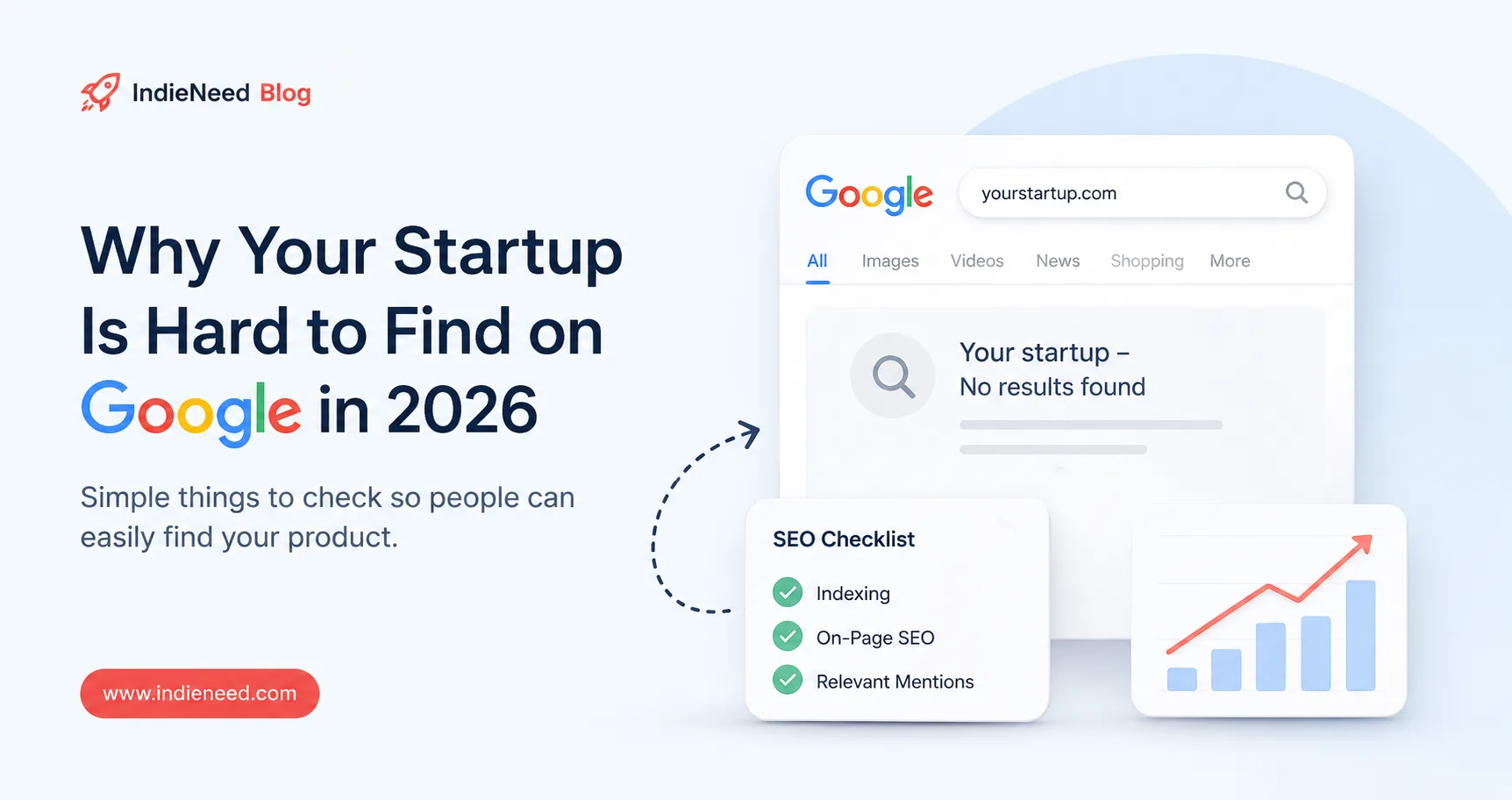
Launched your startup but cannot find it on Google? Here are the simple things worth checking before worrying about rankings.
Aug 29, 20264 min read
On this page
You launched your startup.
The website is live. The product works.
But your startup is still difficult to find on Google.
For a new website, this is common. Google has to discover the site, understand what it is about, and decide which queries it is relevant for. That takes time even when you have done the basics well. This guide is a practical checklist of things you can actually check — not a ranking promise.
Check if Google can find your pages
Search:
site:yourdomain.com
If important pages are missing, check whether they are blocked from indexing.
Also submit your sitemap in Google Search Console. Confirm:
robots.txtdoes notDisallowthe pages you want indexed- those pages do not send
noindex - the canonical URL is the URL you actually want indexed (www vs non-www, https)
- the sitemap lists those same canonical URLs, not redirects or 404s
If Search Console shows a page as “Crawled — currently not indexed”, treat that as a quality and uniqueness problem, not a trick to bypass. Improve the page, make sure it is linked from somewhere Google already knows, and wait.
Explain your product clearly
Your homepage should quickly answer:
- What does your product do?
- Who is it for?
- What problem does it solve?
Avoid vague marketing words.
Clearly explain what your product actually does. Write the sentence a stranger could repeat after ten seconds on the page. If two visitors would describe two different products, the page is not specific enough for people — or for search.
Do the same on the product, pricing, and about pages. Repeat the product name the way you want it remembered. Keep the language consistent across title, heading, and first paragraph so the page is not sending mixed signals.
Create useful pages
Do not depend only on your homepage.
Useful pages can include:
- Features
- Pricing
- Use cases
- Documentation
- Comparisons
- Helpful guides
Only create pages that genuinely help visitors. Thin pages that repeat the homepage do not give Google — or a person — a reason to prefer them.
Each page should have one job. A pricing page should explain plans, limits, and what happens after signup. A use-case page should describe one audience and the workflow they care about. If you cannot say what unique question a URL answers, it is not ready to publish.
Get relevant mentions
Share your startup on relevant product directories and founder communities.
Focus on quality sites related to your product instead of submitting to hundreds of random directories.
These mentions can also help more people discover your brand. They only help if the listing is accurate: a real description, a working URL, and a page on your site that matches what the directory promised.
If you are choosing where to list a startup, start with places that match your audience. A curated startup directories guide is more useful than a spray of low-quality submission forms.
Publish content people actually need
Do not publish articles only to target keywords.
Write about real questions your users have.
Share useful:
- Lessons
- Comparisons
- Experiments
- Product insights
- Problems you solved
One useful article is better than many generic posts. If you would not send the article to a customer, do not publish it for search.
A practical test: after reading the page, can someone do the next step (install, sign up, compare a plan, fix a setup mistake) without guessing? If not, add the missing steps before you worry about titles.
Technical basics that still trip people up
Before you rewrite the whole site, check the boring layer:
- The site loads over HTTPS and does not bounce between http, apex, and www
- Mobile layout is readable without horizontal scrolling
- Important text is in HTML, not only inside images
- Product and docs pages return 200, not a soft 404
- Structured data, if you add it, matches what is visible on the page — no invented ratings or prices
None of these guarantee rankings. All of them prevent Google from discarding a page you already wrote.
Give it time
New websites rarely rank immediately.
Keep improving your pages, publish useful content, and earn relevant mentions.
Avoid SEO shortcuts.
Make it easy for both users and Google to understand what your startup does. Then keep shipping the product. Discovery follows a site that is clear, crawlable, and actually helpful — not a site that only asks to be found.
Launch your product on IndieNeed
Free to submit, hand-reviewed, and you pick the launch day.
Submit a productProducts to explore
Related articles
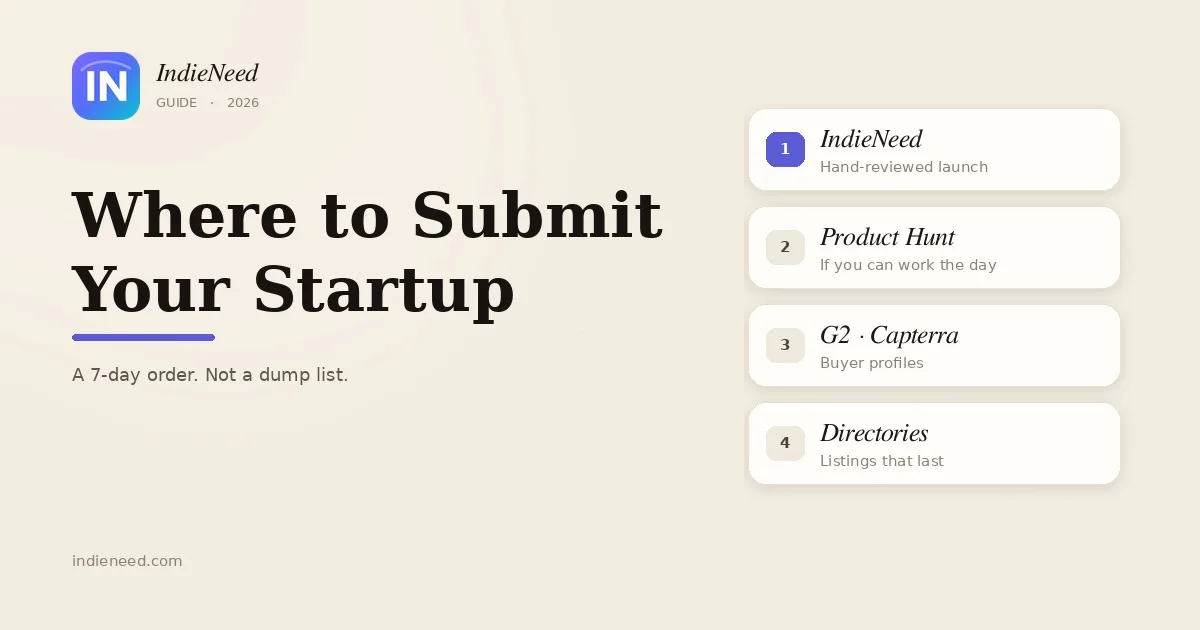
Where to Submit Your Startup in 2026
Most founders dump their product into 80 sites and hear nothing. Here is a one-week order that actually gets visitors, listings, and a few real backlinks.
Sep 20, 20269 min read

SaaS Launch Checklist: 25 Things to Check Before You Launch
A simple SaaS launch checklist for founders covering everything worth checking before, during and after launch day.
Sep 15, 202611 min read

How to Get Your First 100 Users for Your Indie Product
Your product works — but nobody knows it exists. Here's the exact one-week playbook indie makers use to go from zero to their first 100 users.
Aug 14, 20266 min read